Sunday, 17 March 2013

Proxy data

What is proxy climate data?

Proxy climate data is an indirect measure or estimate of what the climate was like by indirect measurements (not with a thermometer or other instrument).  Most proxy data substitutes for direct data that predates accurate temperature measurements either locally or globally.

Direct measurements date back to the invention of reliable thermometers.  Countries with strong naval histories tend to be the earliest recordings of weather and temperature.  Accurate thermometers became available in the 18th century.

There are 2 ways historical climate can be determined.  The first way is by accessing tree rings.  This type of proxy data is useful for looking at local climates in terms of either temperature or rainfall patterns.  The dark regions or rings are usually associated with winter growth with the light ones being summer growth.  A large gap between dark rings indicates good growing conditions while narrow gaps indicate poorer growing conditions.


Ice core sampling produces alternating light (summer snowfall) and dark (winter snowfall) bands.  The thickness of the layers is a good indicator of temperature.  In addition, gas bubbles trapped in the layers can be extracted and tested to see what the atmosphere was like at the time of deposition.


This has led to some alarm owing to the rapid rise of CO2, a result of burning fossil fuels for just over 200 years.  When CO2 levels and estimated temperatures are compared, there appears to be a strong link.  The spike in CO2 in recent times is unprecedented for the last 500,000 years.  This is causing considerable debate now as groups argue for and against the link of CO2 and global warming.


Thursday, 7 March 2013

Carbon "Locked Away"

One of the things that stromatolites and other photosynthetic organisms have done over time has been to "lock away" carbon.  They remove carbon dioxide during photosynthesis:


These carbohydrates have been used to:

  1. Make more biomass (plant mass or growth)
  2. Enrich the soil with organic matter
  3. Removed carbon long term and be stored as coal underground.

In addition, carbon dioxide is removed when it dissolves on sea water.  It is combined with calcium by many mollusks and corals to make calcium carbonate or limestone.  

When the reef is buried or compressed the process of limestone formation is complete.  This kind of removal is another long term storage way of storing carbon and keeping locked out of the atmosphere.


It is fortunate that we have this means of removing carbon (especially carbon dioxide) out of the atmosphere and storing long term (i.e. 10's or 100's of millions of years). It is this reason that the planet has had a stable climate for so long.  If this hadn't happened Earth may have shared the same fate as Venus with a runaway greenhouse effect and surface temperatures over  400 Celcius.

Monday, 4 March 2013

Earth's Atmosphere over time.


The Earth's early atmosphere would have consisted of light volatile (low boiling point) gases contained in the meteorites and other bodies that were colliding with Earth.  These would have escaped into space.  Gases such as hydrogen and helium, bromine and iodine would have been lost very early on. 


As the crust formed on the earth and began to stabilise (around 3.8 billion years ago), volcanoes would have been the major contributor of the atmosphere.  This process is called outgassing.  Analysis of volcanoes today give us a clue to what may have been in the Earths "2nd atmosphere".  One point to note is the absence of oxygen. 


With the rise of the stromatolites and removal of iron from the oceans, oxygen began to accumulate in the atmosphere.  Since they began photosynthesis, the amount of CO2 also fell from the atmosphere.


The combine efforts of stromatoloites and the other photosynthetic organisms that followed lead to the composition of the atmosphere that we have today.  These levels are pretty typical of the planet for the last 450 million years.


Thursday, 21 February 2013

Stromatolites, Photosynthesis and Banded Iron


It is thought that for the time from 3.5 - 1 billion years ago that stromatolites dominated the shallow seas around continents.

Stromatolites are made up of photosynthetic bacteria that form a colony by sticking together with mucous.  Sediments from the water also stick to the mucous.  As the cells divide the new cells that form on top block the light out from those below.  While these die, they contribute to the upward growth of the stromatolite forming a column.


Stromatolites are by far the oldest non-microscopic fossil found on Earth.  The oldest are found in the Pilburra region of Western Australia and are thought to be around 3.4 billion years old.


The early Earth's oceans had a lot of dissolved iron in them.  From space, the oceans would have appeared green from all the iron, rather than the blue of many famous space images.  Iron can stay dissolved in water if no oxygen is present.  When dissolved iron comes into contact with water, it chemically combines to form solid iron oxide.  When that happens, the iron settles out of solution.  


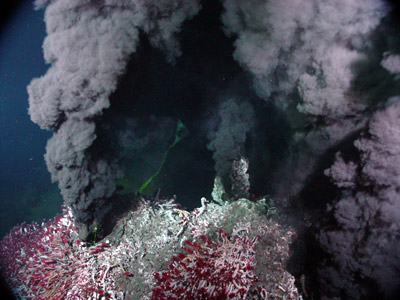
This iron was thought to enter water from volcanic vents where water mixed with rising magma.  The water would dissolve some of the iron from the magma and would heated up.  As a result, jets of iron rich super-heated water would enter the oceans.  Some of these exist at mid-ocean ridges today.  The black plume is from iron compounds in the water.


So as the iron rich water circulated and came to the areas where stromatolites (and therefore oxygen) were present, it would react, form a solid and settle out forming an iron rich sediment layer (see image above).  When either the iron or the oxygen was exhausted from an area, it would mean that a layer of iron poor sediment would be placed on that.


The reasons for this layering of iron rich and iron poor sediments has been subject to a number of hypotheses.  These include:

1. Cycling of ocean currents replenishing the water with iron after its removal from the water by oxygen.

2. Seasonal variations of temperature which affects the rate of photosynthesis and therefore oxygen levels

3. Death and regrowth of stromatolite bacteria from oxygen poisoning.  The bacteria die as oxygen rises.  Any remaining oxygen is removed by the iron.  The bacteria regrow and oxygen levels rise.  The cycle starts again.


About 1.5 billion years ago (other estimates are earlier and vary), the formation of banded iron stopped.  This is because the iron levels in the oceans were near exhaustion and the new iron entering the oceans was reaction in oxygen rich waters which were deeper and well away from stromatolites.  As a result oxygen could now accumulate in the atmosphere and this again would lead to dramatic changes in the chemical makeup of the planet.


The start of life on Earth


The Urey Miller experiment showed that the chemicals of life on Earth could be produced on Earth under the conditions that were thought to be occurring between 3.5 and 4 billion years ago.  Geological evidence tells us that liquid water was around and that no oxygen was present at this time.  

Some of the mudstones that make up the Barbeton mountain range in South Africa are up to 3.5 billion years old.  Microscopic analysis of these suggests that there are fossilised bacteria in these rocks.  Not only do they look similar to modern bacteria, but some appear to be dividing, an indication of life.

Similar finds of bacteria have recently been announce in Western Australia.


The step from the chemicals of life to life itself is not well understood.  While scientists have been able to make cell components, they have been unable to asseble them into anything resembling a cell.  It is an area of some molecular biologists whose aim is to make a "synthetic cell".


How did the first bacteria obtain energy and nutrients?
It is possible that the earliest bacteria consumed the complex molecules that were formed before life arose. That would make them heterotrophic ("eats others").  As these molecules were exhausted, some bacteria were utilising the energy provided from minerals in volcanic springs.  These types of bacteria are autotropic (make their own food), more specifically chemoautotrophic (make their own food using simple chemicals).  However, some bacteria began using a far more available source of energy to make their own food, the sun.  

This was the start of photosynthesis for life on Earth, and would allow some organisms to produce their own food by sunlight.  This was the beginning of photoautotrophic life on Earth.  One of the by-products of this was oxygen.  It was this oxygen that would change everything for Earth and shape it's future.


Wednesday, 13 February 2013

The Urey Miller Experiment


In 1953, Stanley Miller, a PhD student, proposed to his supervisor Harold Urey, an experiment to test if the chemosynthetic origins of life were possible under the conditions of what early Earth was like.

This would in part answer the chicken and the egg question about whether it was possible for the early Earth to produce the chemicals needed to sustain life, before life itself actually got going on Earth.


Energy source and some of the gases that Miller proposed to use.           Note NO OXYGEN.

Miller then set up his experiment as follows:


Over a number of days the apparatus showed orange brown materials sticking to the glass and in solution.  Chemical analysis showed the following:


The final group of materials include amino acids (used to make proteins). Other substances include metabolites that certain types of cells can get energy out of.  


The findings were significant for a number of reasons:


  1. The early Earth could not have had oxygen present (supported by other geological evidence)
  2. The early Earth had conditions that could have allowed for the generation of molecules that would sustain life
  3. Other variations of the experiment showed that molecules that could be used in DNA and RNA could be produced.


Differentiation of the Earth

As we covered previously, the Earth was likely formed from the collision of dust and rocks circling the sun.  The kinetic energy of these collisions was converted to heat.  Because of the heat and constant bombardment the very early Earth would have been a largely molten homogeneous mass (1).

As the bombardment slowed and essentially ceased, the materials that made up the Earth would begin to sink or float depending on their density.  Lighter less dense materials float, while the heavier denser materials sink.  As the surface of the Earth cooled, a solid crust formed with lighter water covering most of it and even lighter gases surrounding everything.

This process is differentiation.